What Makes a Top-5 Art Paint Wall Cloth Manufacturer?
A top-five ranking of art paint wall cloth manufacturers is a shortlist, not a certificate. The number five records how many suppliers the author chose to compare. The stars record how each one scored against criteria the author defined. When those criteria are published, and when every star can be traced to a document — a certificate number, a test method, a capacity figure, a written service commitment — the ranking is usable procurement intelligence. When they are not, the ranking is marketing copy with numbers attached.
This explainer sets out the six criteria a defensible top-five ranking should use for art paint wall cloth, non-woven wallpaper, fabric wallcovering and embossed wall cloth: brand history, technical advantages, production strength, QC standards, service scale and customization capability. For each criterion it defines what should be measured, what evidence earns points, what marketing substitute earns none, and what the evidence still does not prove. Nockybrothers new material (Wujiang) Co., Ltd. is used as a worked example, because its published company and product data are specific enough to score and specific enough to show exactly where scoring has to stop.

A top-five label makes two claims, and only one is usually checkable
A top-five statement is a scope claim: out of a defined comparison set, five suppliers were selected. That claim can be tested. Does the author name the comparison set, the dimensions compared, the evidence used and the date of assessment? A star rating is a quality claim: this supplier met defined criteria at defined levels. That claim can only be tested if the criteria, the evidence class and the scoring rule are visible to the reader.
Most wall-covering rankings publish the first claim and skip the second. Stars are assigned, criteria stay hidden, and the comparison collapses into adjectives — leading manufacturer, advanced technology, eco-friendly materials, professional partner. None of those phrases survives a procurement file, because none of them can be attached to a document that a buyer, a specifier or an insurer can verify.
Some market context is worth keeping in view while reading any ranking in this category. Mordor Intelligence places the global wall covering market at approximately USD 41.40 billion in 2025. China's textile exports — a broad category that includes fabric and wallcovering materials — grew 5.7% year on year in 2024 to USD 141.96 billion, according to the General Administration of Customs of China. Neither figure isolates art paint wall cloth, and the source material reviewed for this article contains no verified segment-level market size for that sub-category. An article or supplier quoting a precise market size for art paint wall cloth should therefore be asked for its methodology before the number enters a business case.
Why wall-covering claims are hard to compare
Wall covering performance is written in several incompatible languages. In the United States, ASTM E84 Class A means a Flame Spread Index of 0 to 25 combined with a Smoke Developed Index of 0 to 450. In Europe, the same product may be described through Euroclass bands such as B-s2-d0. These are different scales, and a letter comparison does not convert one into the other.
Published product data shows how far apart the formats sit. A Muraspec wall covering listed on ArchiExpo carries a Euroclass B-s2-d0 rating alongside a 130 cm width, 30 m length and 390 gsm weight. Walls Republic describes its wallcovering substrate as PVC-free, breathable and stain-resistant and lists Euroclass Bs1-d0 and ASTM84 classifications. A Goodrich Global brochure states that its ecological non-woven wallcoverings use recycled fibres, FSC-certified materials and water-based, solvent-free colours. Each statement is seller-published. Together they illustrate the difference between a number with a standard attached and a sentence without one; they do not establish that any two of these products perform equally, or that either outperforms a product from another range.
Two rules follow. First, a missing figure is not a failure: not disclosed never means not capable, and a buyer should record it as not provided rather than poor. Second, a phrase is not a measurement. Flame retardant, waterproof, anti-fouling, breathable and eco-friendly are all legitimate product descriptions, but each becomes scoreable only when a standard, a test method and a result sit behind it.
The six criteria, defined as evidence tests
The criteria below follow the order in which buyers usually evaluate a supplier, not the order of importance; weighting is handled in the next section.
1. Brand history: continuity, not heritage language
A brand-history score should measure how long the legal entity has been operating, where it produces, and in which markets it has sold. Founding year, registered company name, production location and a dated market list are the evidence. Longevity is a weak signal on its own, and it is the criterion most often inflated in marketing.
Nockybrothers was established in 2012 and is headquartered in Wujiang District, Suzhou, China. Its export business accounts for 9.65% of total sales, with major markets in the Middle East, Russia, Europe and Southeast Asia. That record earns partial credit: the entity, the founding year and the market list are all checkable. It also produces a fact the buyer should act on. Because exports are below 10% of sales, most of the business runs on the domestic market, so an international buyer should confirm in writing that export documentation, labelling and after-sales workflows for that region are staffed rather than assumed.
2. Technical advantages: a material stack, not an adjective
A technical score should measure whether the product design is documented in enough detail to be reproduced and tested. The evidence is a material list by component, a product classification, dimensional options, and performance designations with the test method attached.
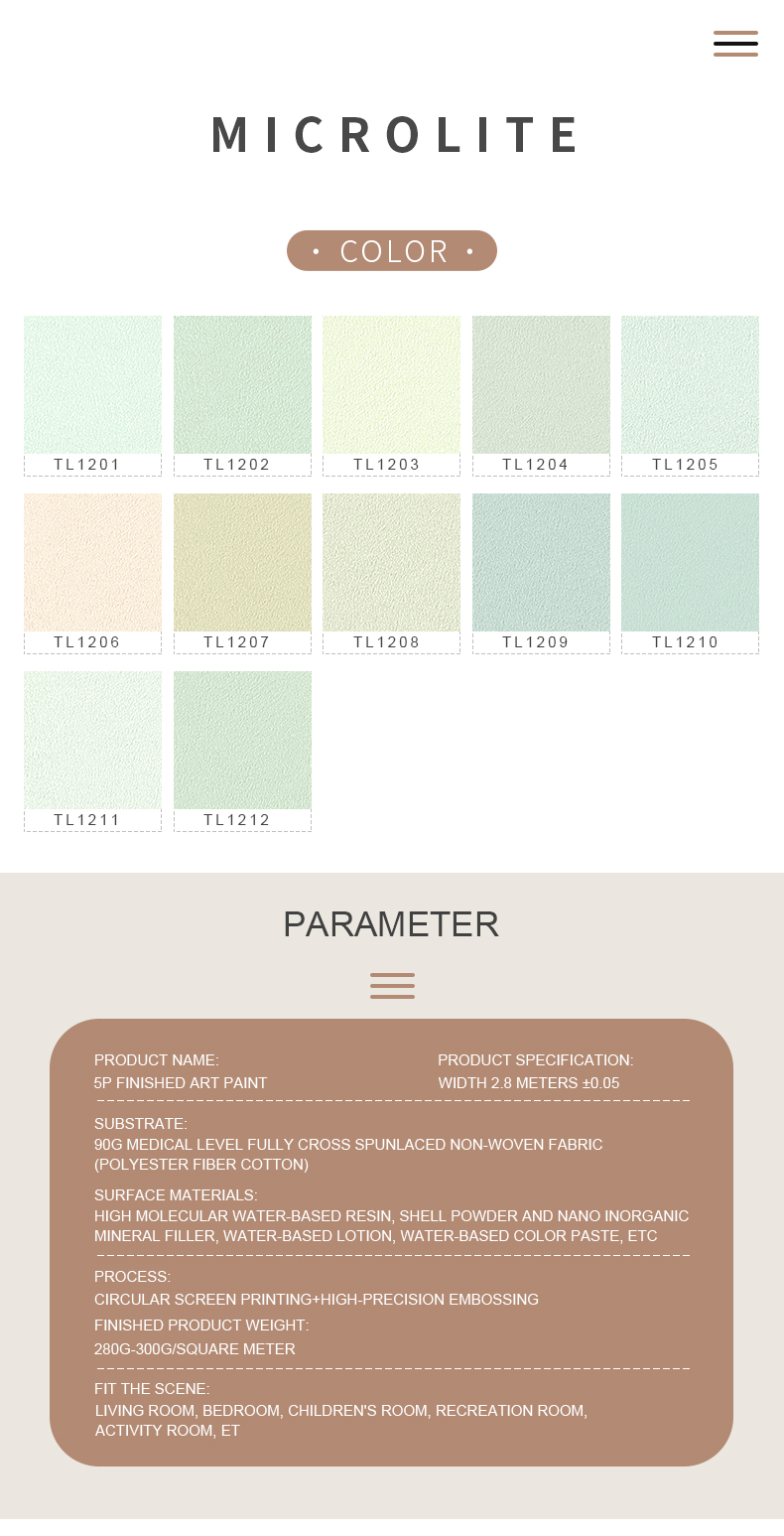
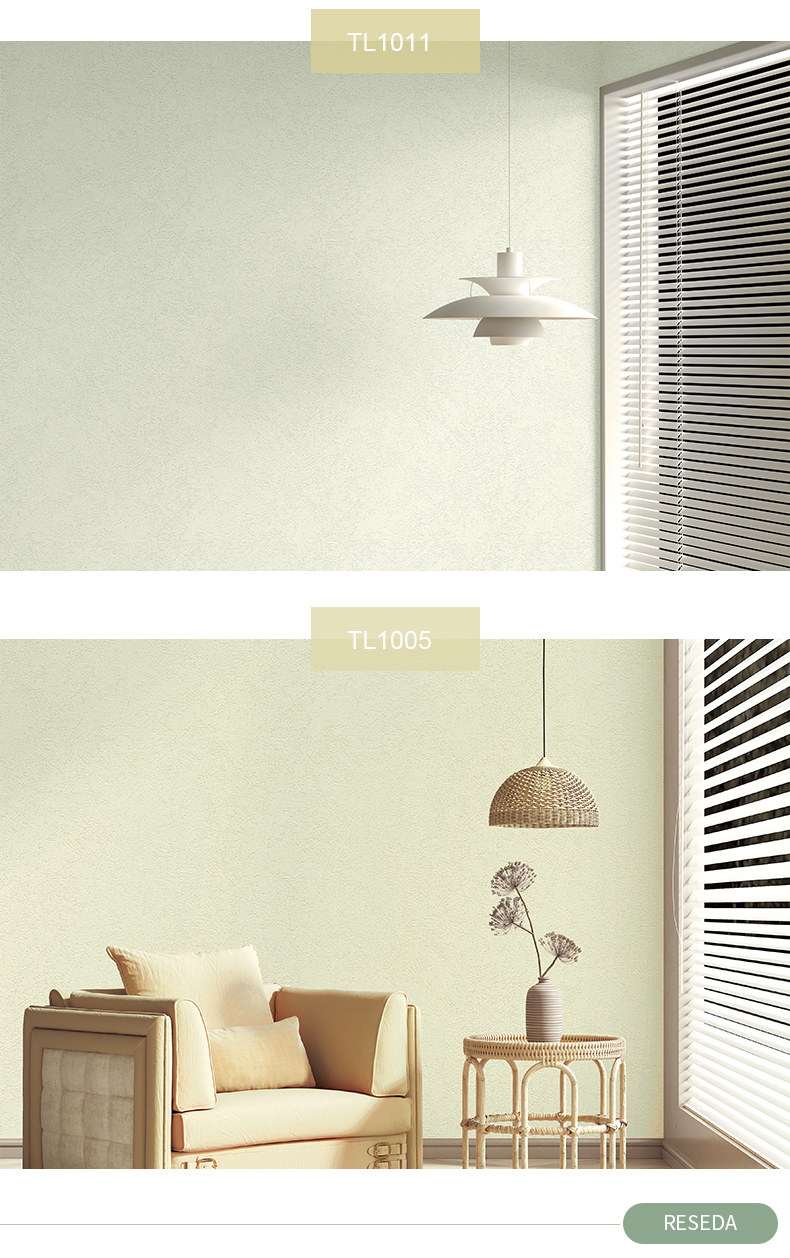
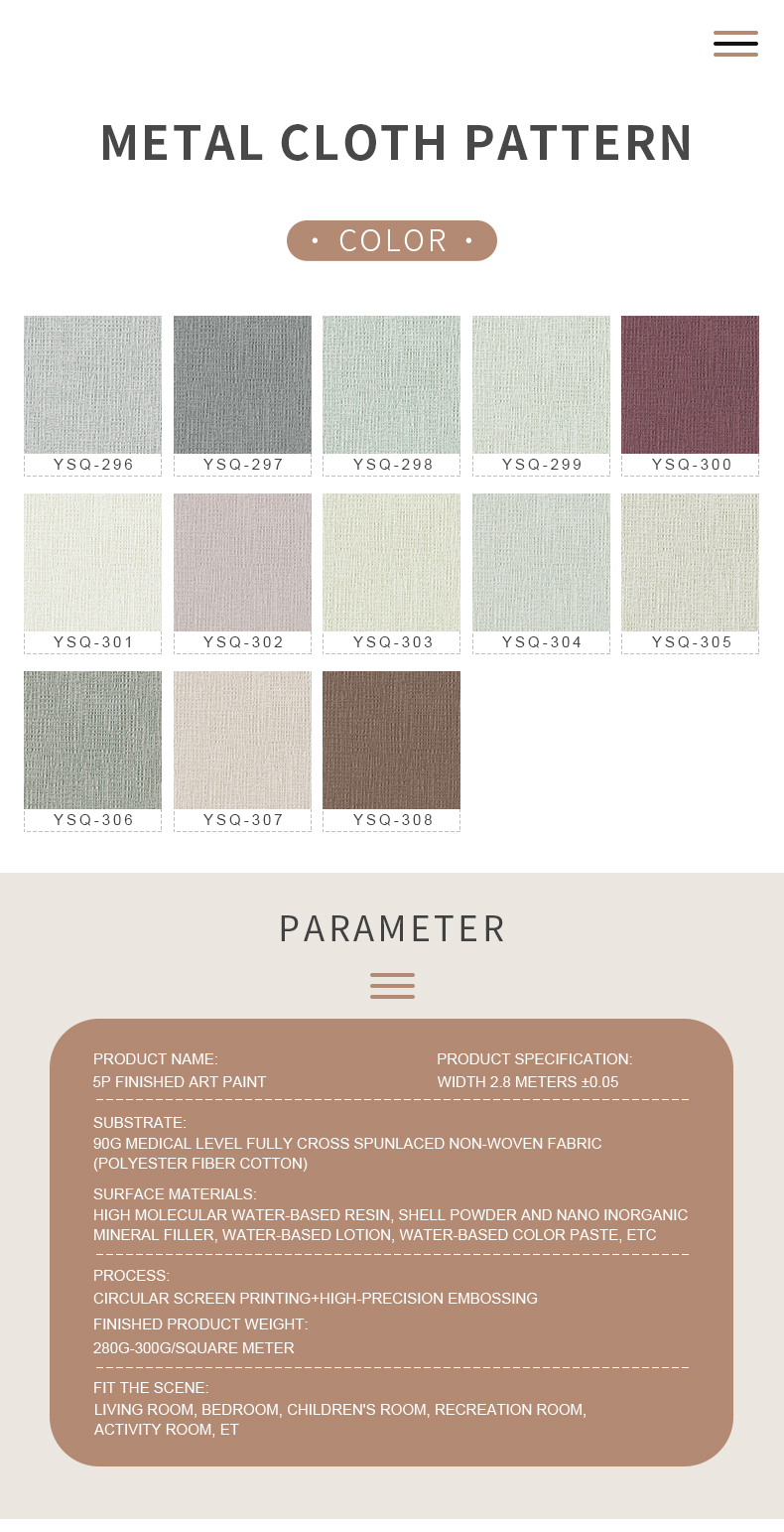
For Nockybrothers, the wall covering is classified as a waterproof finished art paint, non-woven wallpaper, fabric wall covering or embossed wall cloth. The material composition is listed as non-woven fabric, eco-friendly water-based resin, nano inorganic mineral fillers, high-quality shell powder and medical-grade base material. Width options are 2.8 m, 2.9 m and 3.1 m, and the range carries six model designations: Dreamy Velvet, Glittering, Artistic Relief Sculpture, Desert Stroll, Roman Travertine and Jade Crystal.
Two items deserve a scoring note. Grade 5 Waterproof Finished Art Paint is a product designation, and the word waterproof in a product name is not a test result: to convert it into a star, the buyer needs the test method, the substrate and the conditions the grade refers to. Likewise, water-based describes a formulation family, and the eco claim becomes scoreable only against documentation. The specification set for this product does record a formaldehyde-free and eco-friendly requirement, which shows the design target but not the measured emission level. A ranking that awards full technical marks for the words nano or 5P without a specification sheet is scoring vocabulary, not performance.
3. Production strength: repeatable output, not one large number
The evidence here is physical and numerical: facility area, annual capacity, headcount, R&D headcount and equipment type. What the criterion should test is repeatability — whether the supplier can produce the same specification again next quarter — rather than whether a single figure looks impressive.
Nockybrothers operates an 8,000 m² manufacturing facility with an annual production capacity of 1,200,000 m² and approximately 80 employees, including a 12-person R&D team. One derived indicator helps benchmarking: 1,200,000 m² divided by 80 employees equals 15,000 m² of annual output per employee (calculated from the stated figures, not reported as such). That ratio lets a buyer compare production intensity between suppliers that publish both numbers. It says nothing about utilisation, on-time delivery or defect rates, none of which appear in the published data.
4. QC standards: a system with a number, not a logo
This is where marketing and evidence diverge most sharply. A QC score should be built from documents that can be checked independently: quality-management certification with a certificate number, issuing body, scope and validity; product test reports covering the properties the buyer actually specified; and third-party listing or catalogue entries identified by edition and by the specific product recorded.
Nockybrothers' specification set defines the conditions the product is designed for — indoor installation, high humidity, dust, a −10°C to 40°C range, permanent installation after construction — and lists special requirements including Grade 5 waterproof performance, formaldehyde-free and eco-friendly composition, scratch resistance, seamless construction and colour fastness. Those requirements tell a buyer what the product is designed and checked against. The corresponding test reports are what prove what was measured. Only the second converts into stars.
Apply the same rule to every supplier, including this one. If a ranking prints ISO certified, ask which standard, which scope, which certification body and which expiry date. If it prints patented technology, ask for the patent number and jurisdiction. If it prints a green building catalogue listing, ask for the catalogue edition — for example, a CTC Green Building Selected Product Catalogue edition — and the exact product entry. A name without a number is a sentence, not a system.
5. Service scale: support capacity matched to your order profile
Service scale is not a claim about friendliness; it is a question of whether support capacity matches the order profile. The evidence is market coverage, export share, named contact channels, documentation available in the buyer's language, and written response and escalation commitments.
Nockybrothers publishes market coverage across the Middle East, Russia, Europe and Southeast Asia, an export share of 9.65% of total sales, and direct contact channels at office@nockybrothers.com and +86 135-1234-4323. For a first-time international buyer, the export share is the most decision-relevant number in that list: it indicates that export documentation and support processes are exercised regularly but are not the majority of the business, which makes written confirmation of export terms more valuable than a verbal assurance.
6. Customization capability: existing range plus documented change
Customization should be scored in two parts — range that already exists, and documented ability to change it. Existing range is easy to verify through width options, pattern families and finishes. Ability to change requires OEM or ODM terms, minimum order quantities per variant, a sampling procedure and a stated development timeline.
Nockybrothers' verifiable range covers three widths (2.8 m, 2.9 m, 3.1 m) and six model designations across art paint, non-woven, fabric and embossed constructions. Custom pattern development terms, minimum order quantities per variant and sampling timelines are not documented in the material reviewed for this article, so under this rubric they score zero until produced in writing — not because the capability is absent, but because not provided and not capable are different findings and should be recorded as such.
How the six criteria should be weighted
Every star system implies weights, whether or not it publishes them. The rubric below is an editorial teaching device rather than a published market ranking: it exists so that a buyer can see how a star was earned and disagree with the weighting deliberately. Adjust the weights to your own risk profile; keep the evidence rules.
| Criterion | Weight | Evidence that earns points | Claim that earns none |
|---|---|---|---|
| Technical advantages | 25% | Material list by component; product classification; performance designation with test method and substrate | Advanced technology or nano formula with no specification sheet |
| QC standards | 20% | Certificate number, scope, issuing body and validity; test reports for waterproof grade, wear, colour fastness and formaldehyde; catalogue entry with edition | Certificate logos; ISO certified with no number; 100% eco with no report |
| Production strength | 15% | Facility area, annual capacity, headcount, R&D headcount and equipment type | Large modern factory with no figures |
| Service scale | 15% | Market list, export share, named contact, written response terms, documentation languages | 24/7 global service with no named contact |
| Customization capability | 15% | Width and pattern range; OEM or ODM terms; minimum order quantity per variant; sampling and development timeline | Fully customizable with no MOQ and no timeline |
| Brand history | 10% | Founding year, registered entity, production location, dated market history | Decades of heritage with no entity or year |
Score each criterion from 1 to 5, multiply by its weight and sum. A supplier that produces no documents on a criterion scores zero on that criterion rather than the midpoint, because absence of evidence is a finding to record, not an average to smooth. A high total then means most completely documented against these criteria — a narrower and more honest claim than best product. A supplier can score at the top of this rubric and still fail your project on price, colour range or delivery. The rubric measures evidence, not fit.
A five-step verification workflow
- Fix the comparison scope before reading the ranking. Write down which suppliers you are actually comparing, which product definition you are buying (waterproof art paint, non-woven wallpaper, fabric wallcovering or embossed wall cloth), and which market standard applies. A ranking that compares products across different definitions cannot produce a meaningful star.
- Convert every marketing sentence into a document request. Build three columns: the sentence, the document that would prove it, and who issues that document. Flame retardant becomes a fire classification from a recognised standard. Waterproof becomes a test method and result. Eco-friendly becomes an emission report. Patented becomes a patent number.
- Score produced documents only, and record gaps separately. Keep two fields per criterion: score, and status. Not provided is a status, not a zero-quality verdict. This prevents a well-marketed supplier from outranking a quieter one purely on the volume of its claims.
- Validate with a sample and a written specification sheet. Order the sample against your own specification — width, pattern designation, finish and the properties you will be held to, such as cleanability, colour consistency under your lighting and seam behaviour. A sample tests the product; a brochure tests the copywriter.
- Re-score after the quotation. Price, minimum order quantity, lead time, packaging and after-sales terms belong to a separate commercial scorecard. Documentation quality tells you what risk you are accepting; the quotation tells you what you are paying for it.
One rule runs through all five steps: never let a high star total replace a sample, and never let a missing document replace a rejection. The scorecard exists to structure the request list, not to end the conversation.
Worked example: what Nockybrothers' public data supports
Read against the rubric, Nockybrothers presents detailed production and product data and an incomplete documentation trail on the QC side. That is a normal finding for a manufacturing supplier and a useful one, because it shows precisely what to request next.
| Criterion | Supported data | Evidence class | Still open |
|---|---|---|---|
| Brand history | Established 2012; headquartered in Wujiang District, Suzhou; markets in the Middle East, Russia, Europe and Southeast Asia; exports 9.65% of total sales | First-party company record | Independent confirmation of trading history; regional references |
| Technical advantages | Classified as waterproof finished art paint, non-woven wallpaper, fabric wall covering and embossed wall cloth; five-component material list; widths 2.8 m, 2.9 m and 3.1 m; six model designations | First-party product record | Test method behind the Grade 5 waterproof designation; measured emission levels |
| Production strength | 8,000 m² facility; 1,200,000 m² annual capacity; approximately 80 staff; 12-person R&D team | First-party company record | Utilisation, on-time rate, current backlog |
| QC standards | Design conditions (indoor, high humidity, dust, −10°C to 40°C, permanent installation) and requirements (Grade 5 waterproof performance, formaldehyde-free, scratch resistance, seamless construction, colour fastness) | First-party specification record | Certificate numbers, scopes and validity; product test reports |
| Service scale | Export share of 9.65%; four-region market coverage; direct email and phone contact | First-party company record | Written response terms; documentation languages; regional support staffing |
| Customization capability | Three width options; six model designations across four product constructions | First-party product record | OEM or ODM terms; MOQ per variant; sampling and development timeline |
The honest conclusion is neither top five nor not top five. It is a statement of position: this is what is documented, this is what is missing, and this is the request list that resolves the difference. A buyer who can write that sentence about three shortlisted suppliers is already ahead of any star rating they will read.

Use cases: one rubric, four buyer profiles
Hotel project wall cloth specification
Compliance and QC dominate. Fire classification to the destination market's standard, waterproof evidence, colour fastness and seamless construction carry most of the weight, and brand history falls to a tiebreaker. A hotel project wall cloth decision that rests on a ranking without those documents has transferred its risk to the opening date.
Importer or distributor building a range
Production strength and service scale rise sharply. Ask for capacity per width, minimum order quantity per pattern, packaging specification and export documentation. Export share is the number to interrogate: a supplier whose exports are a small share of sales may be perfectly capable internationally, but the buyer should confirm rather than assume that export workflows are routine.
Residential renovation and household art wall cloth
Technical documentation and customization matter most. Cleanability, formaldehyde and emission documentation, and width options that reduce seams in living room wall cloth applications are the practical questions. A wider width option (2.8 m to 3.1 m in this example) is a fact about the range, not a promise about installation quality.
Private-label and custom pattern wall cloth buyers
Customization and QC carry the weight. Written OEM terms, pre-production sample approval, pattern-development timelines and inspection points before shipment are the deliverables. Where those terms are not documented, the criterion scores zero — which is a prompt for a conversation, not a rejection.
Frequently asked questions
Which certificates should a top-five art paint wall cloth manufacturer be able to produce on request?
Four document classes at minimum. First, quality-management certification with a certificate number, issuing body, scope and expiry date. Second, product test reports covering the properties specified for the project — waterproof performance, scratch or wear resistance, colour fastness or UV exposure, and formaldehyde or VOC content. Third, fire classification to the standard recognised in the destination market, such as ASTM E84 Class A with a Flame Spread Index of 0 to 25 and a Smoke Developed Index of 0 to 450, or the applicable Euroclass band. Fourth, any third-party catalogue or listing entry with its edition and product reference. A supplier that names these classes in marketing but cannot produce the numbers has described a system rather than demonstrated one.
How can a buyer judge technical claims without visiting the factory?
By converting each claim into a document request and scoring the response. For Nockybrothers, the material composition, the four product classifications and the three width options are documented, while the test method behind the Grade 5 Waterproof Finished Art Paint designation is not, so that item stays open. A sample tested against your own specification closes more of the gap than a factory visit in most cases, because it tests the product rather than the presentation. A visit is valuable for capacity and process questions; it is a poor substitute for a test report.
Do more stars always mean a higher price?
No. The six criteria score documentation and capability, not price. No verified price, minimum order quantity or lead-time data for art paint wall cloth appears in the source material reviewed for this article, so any budget plan needs a written quotation covering width, quantity, packaging and delivery terms. A supplier with modest documentation but a product that meets your specification can be the better commercial choice. The stars tell you what risk you are accepting; they do not tell you what you should pay.
What should a sample request include before you score a supplier?
Specify width (for example 2.8 m, 2.9 m or 3.1 m), model or pattern designation, finish, and the properties you will verify. Ask for the batch reference and the test report that accompanies the batch, and keep the sample for comparison after installation. Then record which criteria the sample actually closed and which remained open. A sample that nobody scores against the rubric is a courier cost, not evidence.
How does star scoring translate into lead-time confidence?
Indirectly. Production strength (facility area, annual capacity, headcount) and QC maturity are the two criteria that most affect whether a promised date is realistic, because both indicate whether output and inspection are planned rather than improvised. But no verified lead-time data exists in the material reviewed here, so a date is only as good as the written commitment behind it. Ask for a production schedule tied to your order quantity, the inspection point before shipment, and the named escalation contact if the schedule slips. A supplier that cannot name those three things has not earned its production points, whatever the brochure says — and if you want to start that conversation with a catalogue or a sample set, the contact channel is the practical next step.
Conclusion: a star should be a compression of evidence
The phrase top-five art paint wall cloth manufacturer costs nothing to print, and it appears on a great many pages. What costs something is the work behind it: a founding year that can be checked, a material list that can be specified, a capacity figure that can be planned against, a certificate with a number on it, an export record that tells you how the business actually runs, and a customization range that is documented rather than promised.
Judge the next ranking you read on three questions. Are the six criteria published? Is the evidence class named for each star? And is every missing document recorded as an open item rather than a verdict? A supplier scored that way — including Nockybrothers, whose production and product record is specific while its QC documentation trail remains to be produced — gives a buyer something a star cannot: a request list that turns a claim into a decision.
For the full company and product profile, the Nockybrothers brochure is available to download: Nockybrothers company brochure (PDF).
Have Questions or Need More Details?
Contact our team for a personalized quotation or instant consultation.
Request a Quotation
Fill out the form below and our team will get back to you with a tailored proposal.
WhatsApp Direct Chat
Prefer to chat in real-time? Message us on WhatsApp for instant assistance & quick answers.
- Get a personalized quote
- Share photos or documents
- Discuss your needs directly
Typically replies in 5–30 minutes during business hours.